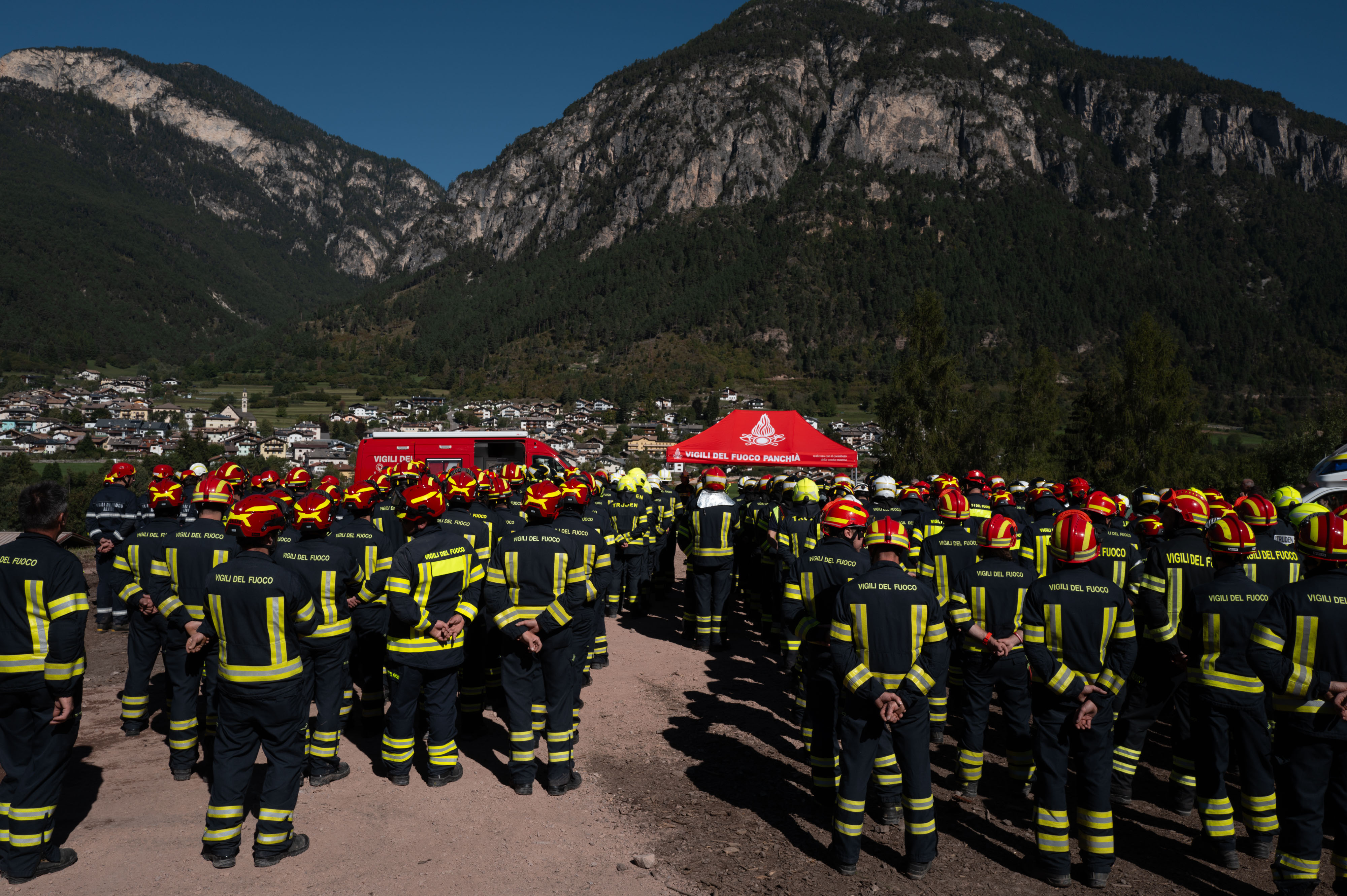
I followed a training exercise of the volunteer firefighters of Val di Fiemme, as they faced different emergency scenarios: a wildfire, a person to be recovered from the water, and a vehicle stranded in difficult terrain.
Three different situations, united by the need to respond with preparation, coordination, and the ability to work together.
From the first operations in the woods of Malga Toazzo, above Panchià in Val di Fiemme, to the recovery of a person in a hard-to-reach area, I documented three of the four planned scenarios, observing the rescuers' work up close.
Through the photographs and testimonies gathered in the field, this reportage tells not only the simulated operations, but also what lies behind every intervention: the training, the teamwork, and the contribution of those who dedicate part of their time to the safety of the community.
Because, before every emergency, there is work that often remains far from view.
In the Woods of Malga Toazzo
The first scenario takes place in the Malga Toazzo area, above Panchià.
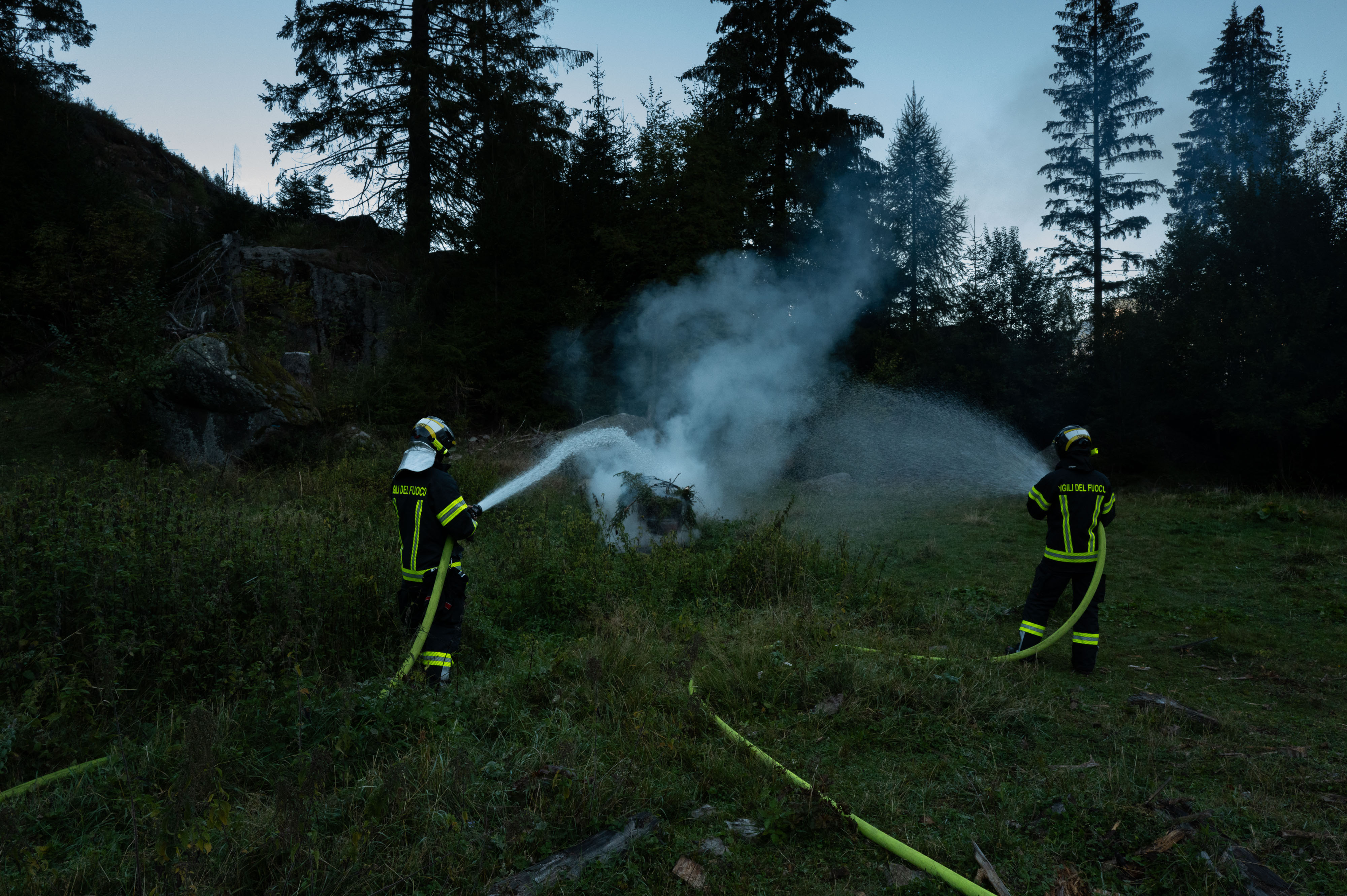
The firefighters simulate a wildfire. The teams reach the intervention area with fire engines and operational vehicles, carrying the hoses from the valley up to the upper part of the forest.
The terrain is steep, the vegetation irregular. Every movement requires attention.
I watch the rescuers as they work among the trees. Smoke rises from the vegetation, water is directed towards the simulated fire front, and the teams maintain coordination throughout the operations.
It is a scene that conveys only a part of the work needed to face a wildfire.
Stefano Sandri, district inspector of the volunteer firefighters, explains the meaning of the exercise.
“Forest fires involve a whole series of operational techniques that must be practised”
Sandri explains that these exercises are organised every year precisely to keep operational the techniques needed to face situations of this kind.
During the interview he also recalls the two major wildfires that occurred during the year, underlining the importance of continuing to prepare.
The goal is not only to verify the ability to intervene, but to maintain a level of preparation that allows the teams to face a real emergency.
When Every Second Counts
The second scenario moves to the water.
The rescuers simulate the search for a person in a river. The operation involves the firefighters, including personnel specialised in water rescue, and the White Cross of Tesero.
Once the person, represented by a dummy, is reached, resuscitation procedures are simulated on the spot.
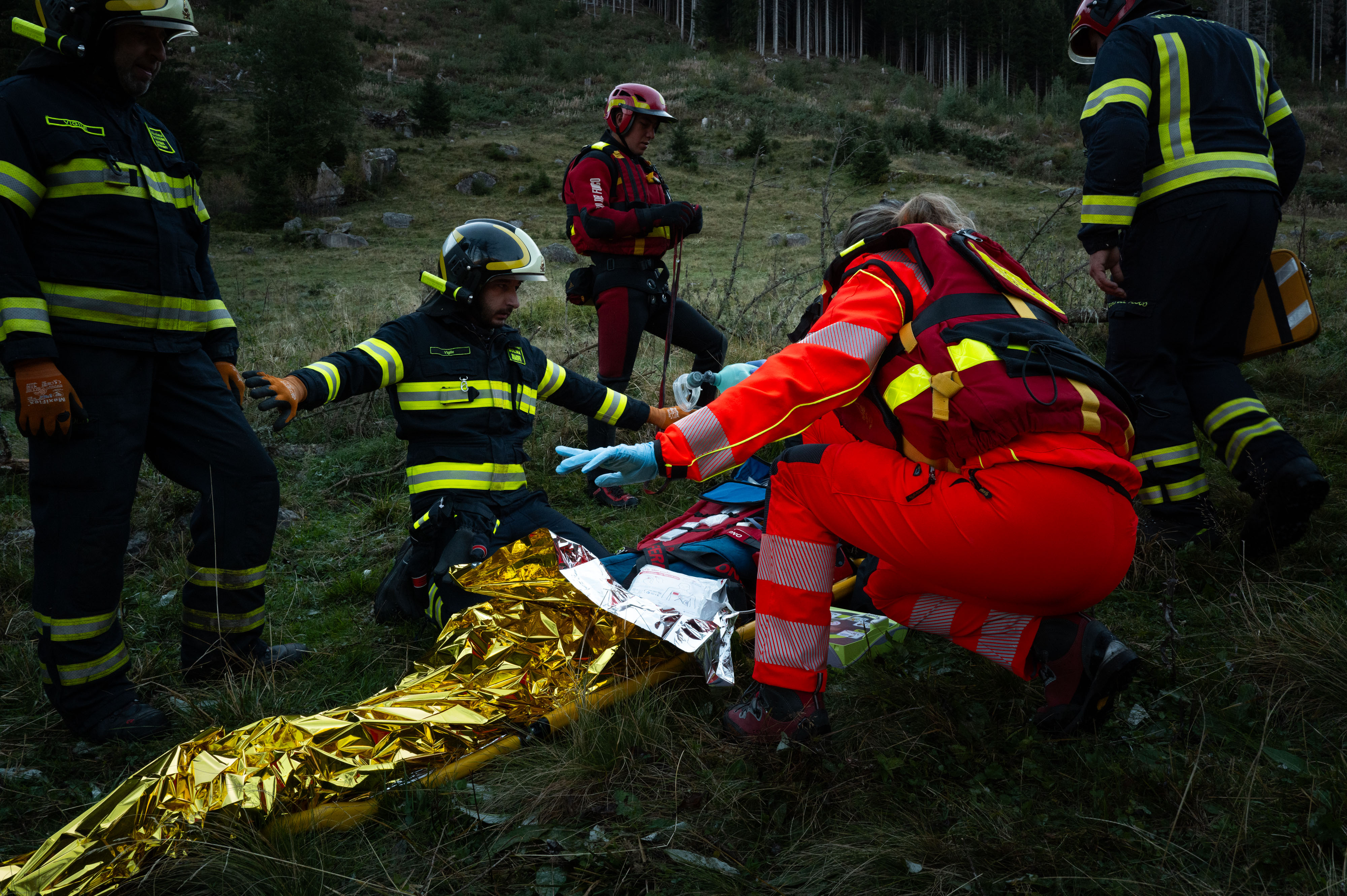
The scene is completely different from the wildfire. Here the attention focuses on the gestures, on the closeness between the rescuers, and on the need to intervene with precision.
The recovery is only one part of the operation. Once the person is reached, the conditions for medical assistance must be guaranteed.
It is work that requires the collaboration of several figures, each with specific skills.
A Vehicle in Difficult Terrain
The third scenario involves an accident with a vehicle that ended up in the water, in an area that is difficult to reach.
The firefighters work to recover the vehicle and the person involved. The operations take place in difficult terrain, where the ground and the position of the vehicle require a coordinated intervention.
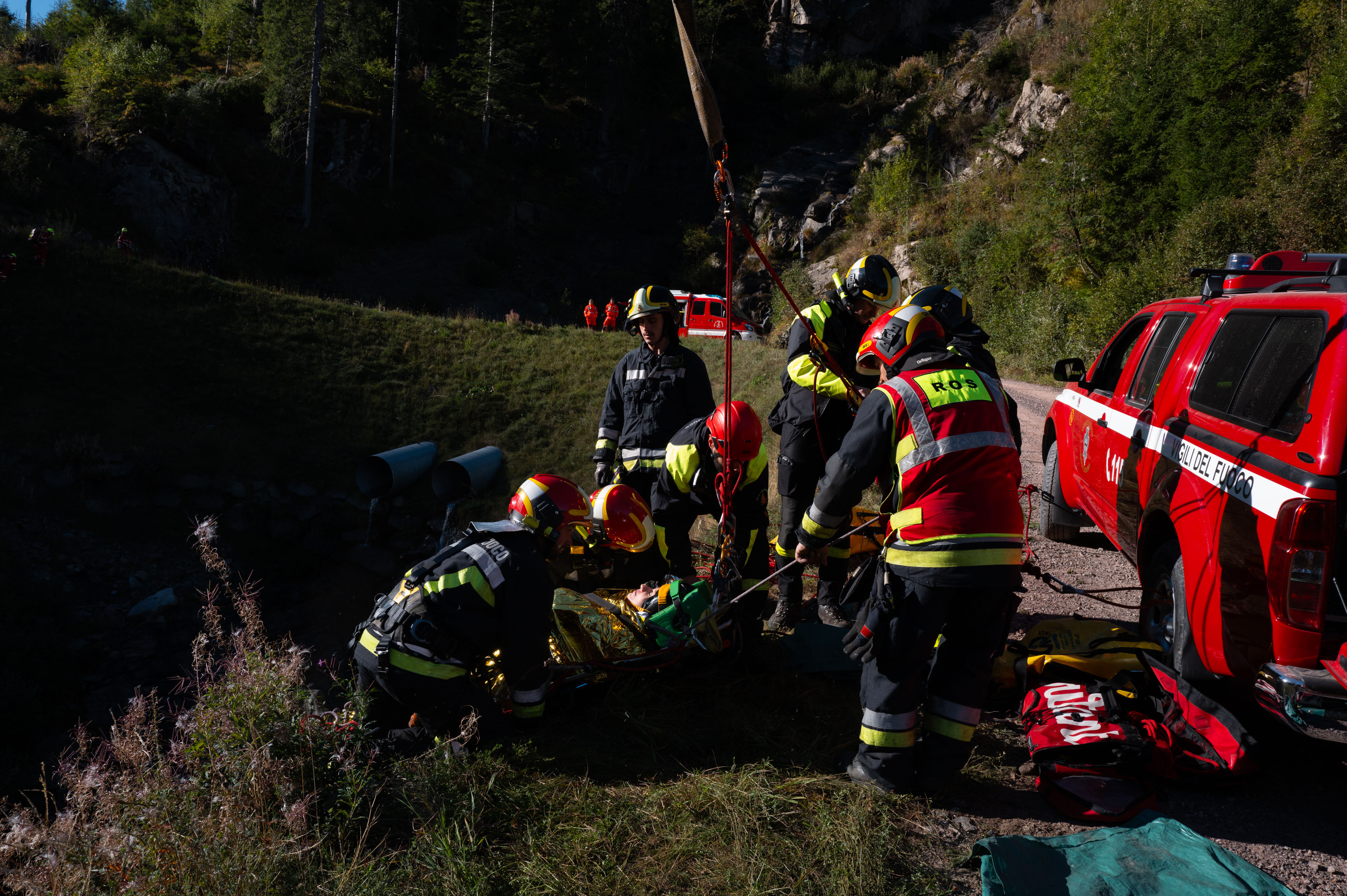
It is one of the situations in which the complexity of technical rescue emerges most clearly.
Around the vehicle, the rescuers organise the operations and work to complete the recovery. Every phase requires attention, especially when a person is involved.
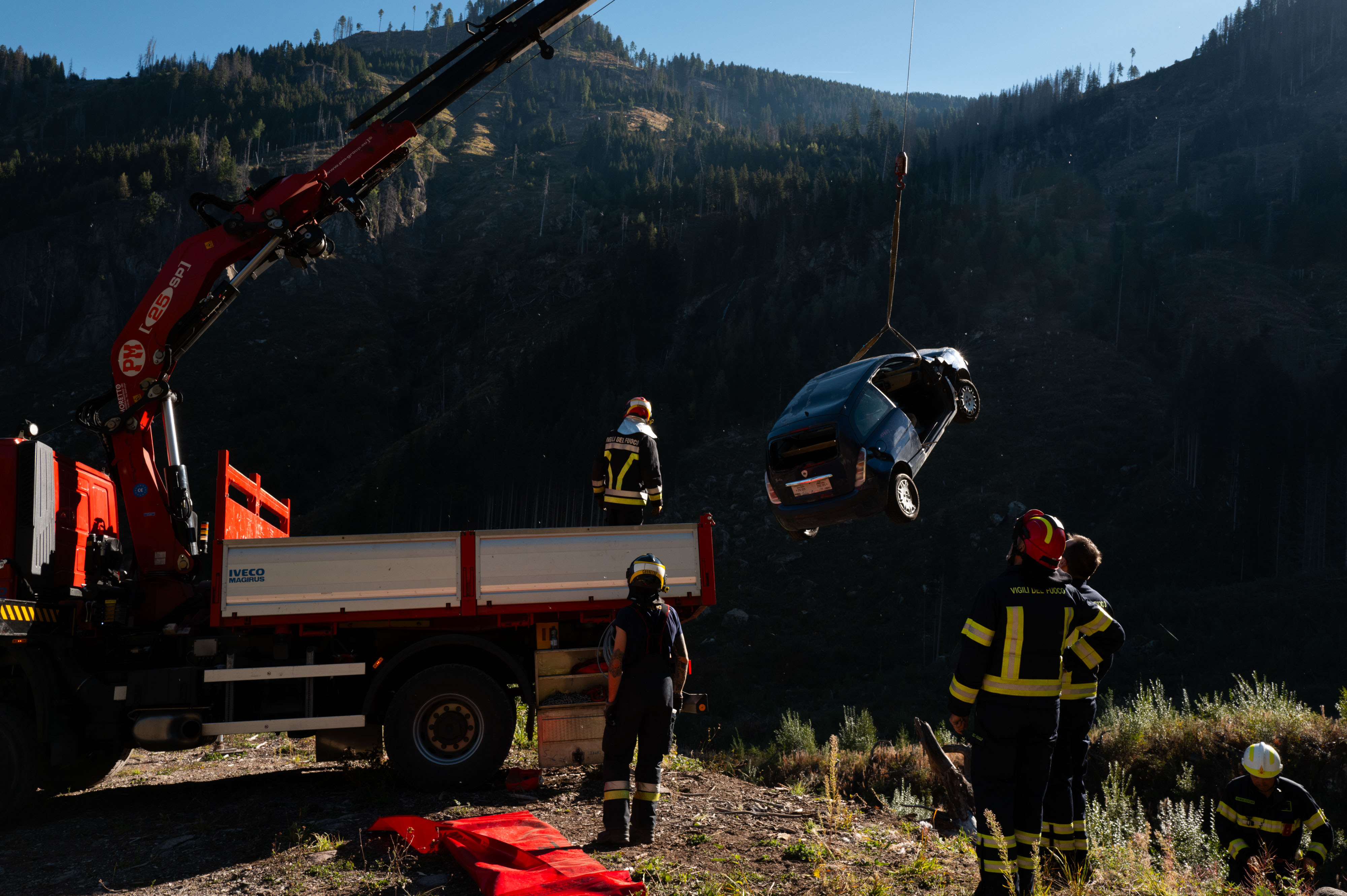
During the interview, Fabio Fipinger, commander of the Panchià Volunteer Fire Brigade and operations commander, explains how even a seemingly minor problem can affect the management of an intervention.
Asked what unforeseen event can put a team to the test the most, he points to communication systems.
“A malfunction in the radio system in the intervention area, where there might be no coverage, could create a communication problem”
Communications are a fundamental part of coordination. A missed call or an area without coverage can make the exchange of information between the teams more difficult.
It is an aspect that rarely appears in the photographs of an intervention, but one that can shape the way the operations are organised.
The Work That Remains Unseen
During the day, one of the questions I carry with me concerns the least visible part of the firefighters' work.
Giovanni Dellagiacoma, a volunteer firefighter, tells me how important the preparation of the equipment, the maintenance, and the training are.
“The fundamental part is preparing the equipment, maintenance, the training every firefighter must complete, practice, and operational exercises”
These are activities that rarely appear in the photographs of an intervention. Yet it is precisely these that make the work in the field possible.
Dellagiacoma also describes how the way the public perceives the volunteers' activity has changed. While alerts once came through the siren, the use of pagers today means that many call-outs remain less visible.
But the rescue work continues even when no one is watching.
The Value of Volunteering
Volunteering is one of the central dimensions of this story.
Senator of the Republic Elena Testor underlines the importance of supporting the volunteer firefighters, recalling that they dedicate their time and their preparation to the safety of the citizens.
“Institutions must support them financially and morally”
During the interview, Testor also stresses the need to encourage collaboration between the different corps and districts, especially when facing large-scale emergencies.
The senator also recalls an amendment to the 2026 budget law, which she presented, intended to support projects of the volunteer firefighters in Trentino, Alto Adige, and Valle d'Aosta.
The value of this network also emerges in the words of Maria Bosin, who recalls her experience during the Vaia storm, when she was mayor.
“I would say they are not important — they are fundamental”
Bosin describes having experienced first-hand what it means to respond during a serious calamity.
In her testimony she recalls the preparation, the coordination, and the mutual support between the corps.
“A precious asset to protect, including through the work of institutions”
Her words bring the story back to the dimension of the territory.
In a mountain community, volunteering is not only an operational resource, but also a presence rooted in everyday life.
Passing on What Has Been Learned
The last photograph of the day looks to the future.
A group of trainees of the volunteer firefighters is gathered in front of the vehicles. Their faces, the uniforms, and the presence of the other rescuers tell a part of the service that begins long before a real intervention.
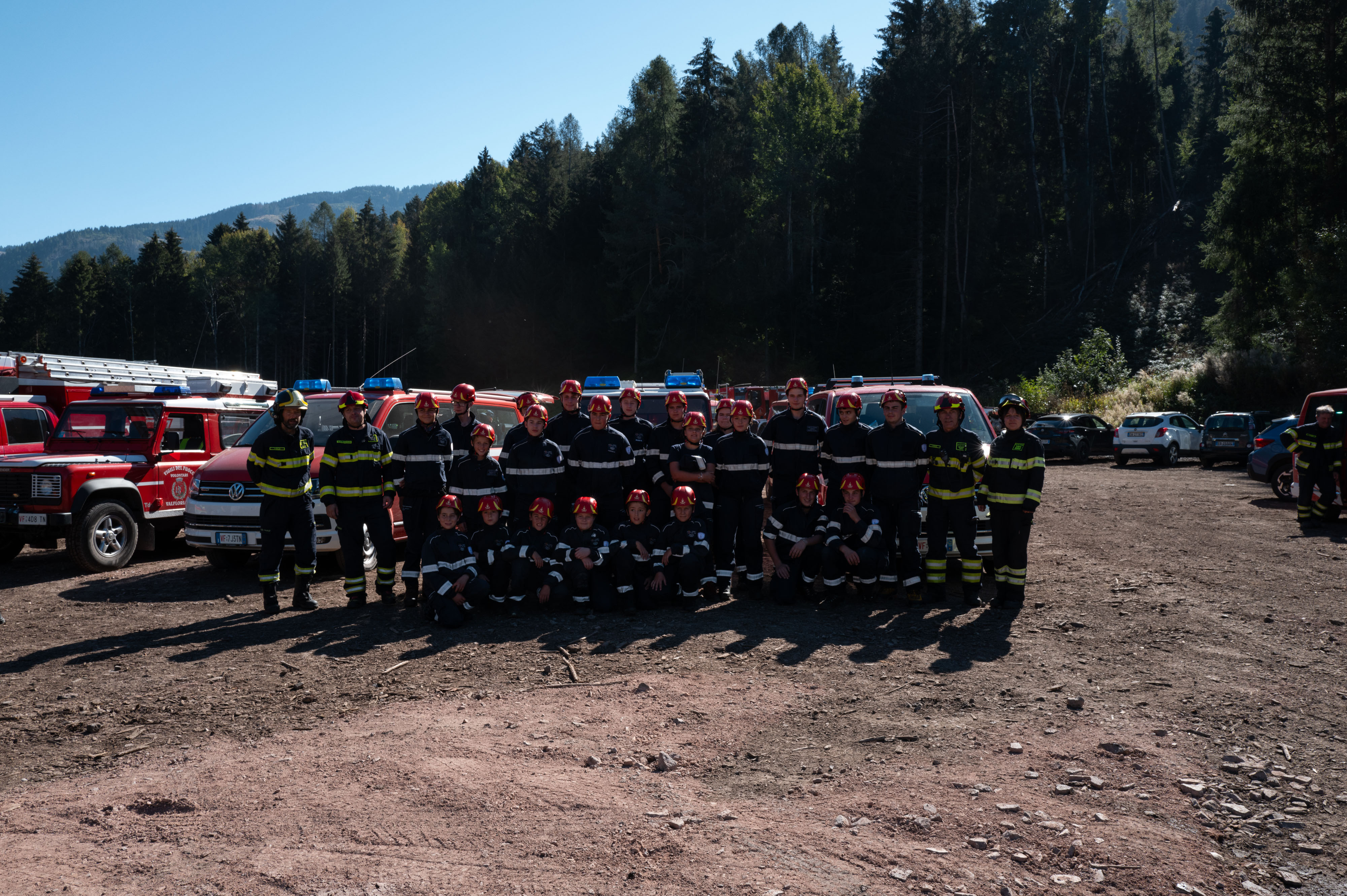
Dario Bellante, the trainees' instructor, talks to me about the importance of passing on to the younger ones what he has learned over his years of service.
“Passing on what you know, knowing that one day you may no longer be there for various reasons — because you have reached the age limit or moved on”
For Bellante, teaching means leaving something to those who will come after.
Not only technical skills, but also the meaning of belonging to a team and of placing oneself at the service of others.
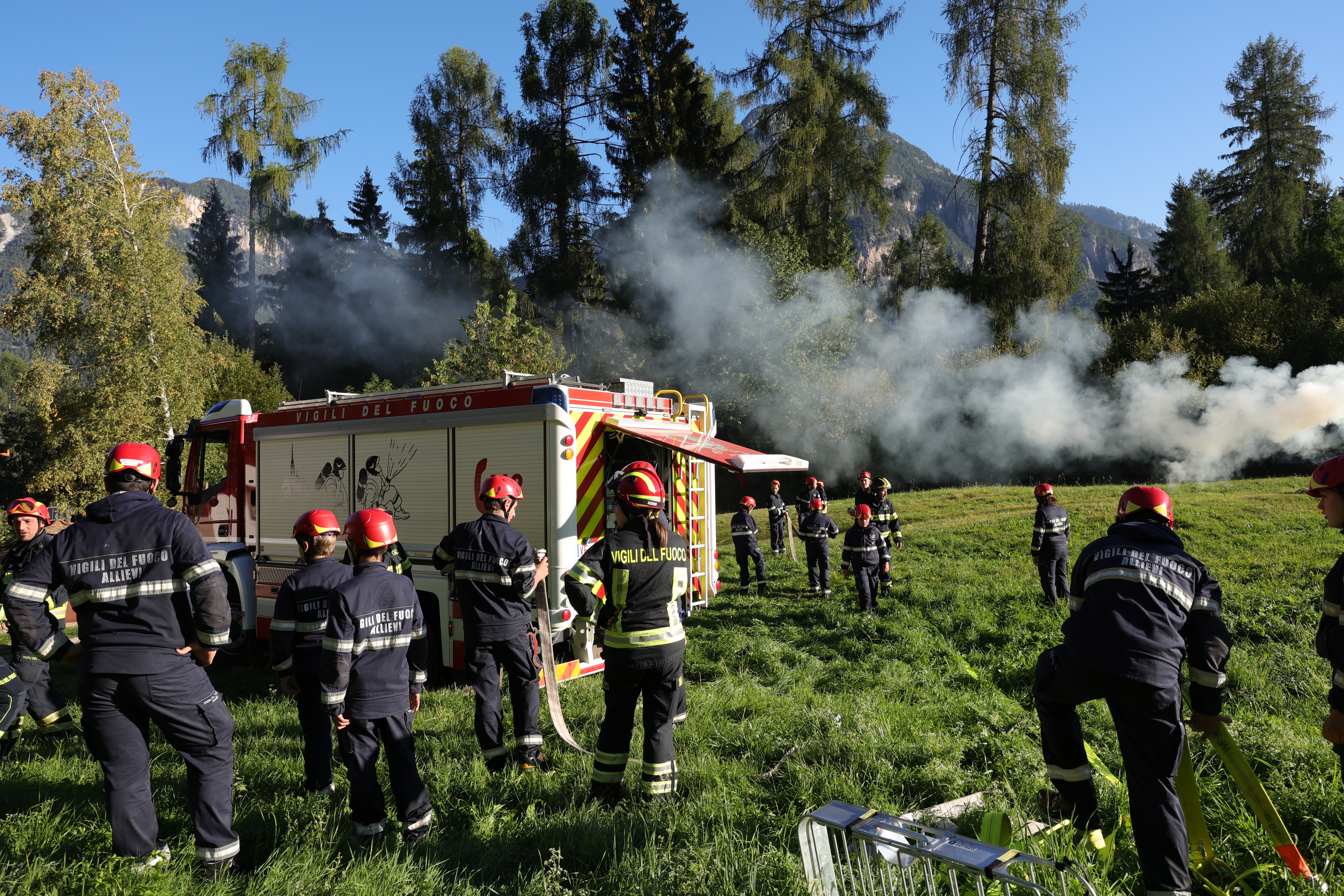
The activity of the trainees thus represents a fundamental part of the future of volunteering.
After the Exercise
The activities come to an end. The vehicles return, the equipment is stowed away, and the rescuers go back to their daily lives.
The images collected during the day tell three different scenarios, but also something that unites them: the need to be prepared and to be able to count on others.
The work of the firefighters does not end when they arrive at the scene of an emergency. It continues in the maintenance, in the training, in the education, and in the time dedicated to the community.
The last photograph looks to the trainees, to those who are learning today what they will one day be able to put at the service of others.
It is from them that the story begins again.
Because behind every intervention there is work that often goes unseen. Made of time, responsibility, and people who choose to be there.
And that is precisely where rescue begins.